

In the first four parts of this series, we explored the shifting academic landscape, challenged long-standing assumptions about teaching and learning, and introduced practical structures—like small-group and station-rotation models—to better meet the needs of today’s students.
Before we move further into standards, assessments, or instructional design, it’s essential to pause and revisit the foundation:
Christian schools exist to disciple students, to shape their hearts and minds to know and follow Jesus.
Because formation is the mission, biblical worldview integration isn’t optional or supplemental. It is the way Christian education was designed to function.
My primary concern is that Christian schools leave the bulk of the Christian school “discipleship experience” to chapels, camps, and spiritual life, and forget that students spend more than 90% of their time in the classroom while on their school campus.
Here is where many schools get stuck:
Teachers are told to “integrate a biblical worldview,”
but they aren’t shown how to do it,
or how to connect it meaningfully to actual standards, skills, and content.

The Mindset Shift: Integration Is Not an Add-On
In many classrooms, biblical worldview integration is:
an opening or closing prayer
a brief devotion or testimony
a Scripture verse on a bulletin board
These are good things and we should keep doing them! However, they are not biblical worldview integration.
True integration happens when we look at the curriculum, standards, skills, and unit objectives and ask ourselves:
“What does the Bible say about this?”
If you remember only one thing from this article, it is to begin asking biblical questions!
Ask them all of the time. Bring biblical inquiry to your classroom and for discussion, exploration, and discovery.
Not in a forced way. Not by stapling Scripture onto content. But by recognizing that all truth is God’s truth and therefore every academic discipline rests on biblical foundations.
The process can be simple:
Evaluate the standard or learning target.
Ask a biblical question connected to the concept.
Answer it from Scripture.
Design activities that help students learn both the academic skill and the biblical truth.
I recommend that this happens at the unit level, especially when you’re starting out in this process. Come up with one biblical worldview question per unit and plan for it accordingly. Therefore, you’ll have explored 5-10 key biblical questions (with answers and learning activities) over the course of the school year.
A Simple, Repeatable Framework for Teachers
Here is a sample biblical worldview table teachers could build for each unit. You could use MagicSchool, ChatGPT, or other AI models to help you with a draft before you make your own edits. I chose some 7th grade ELA standards as an example.
Sample 7th Grade ELA Biblical Integration Chart
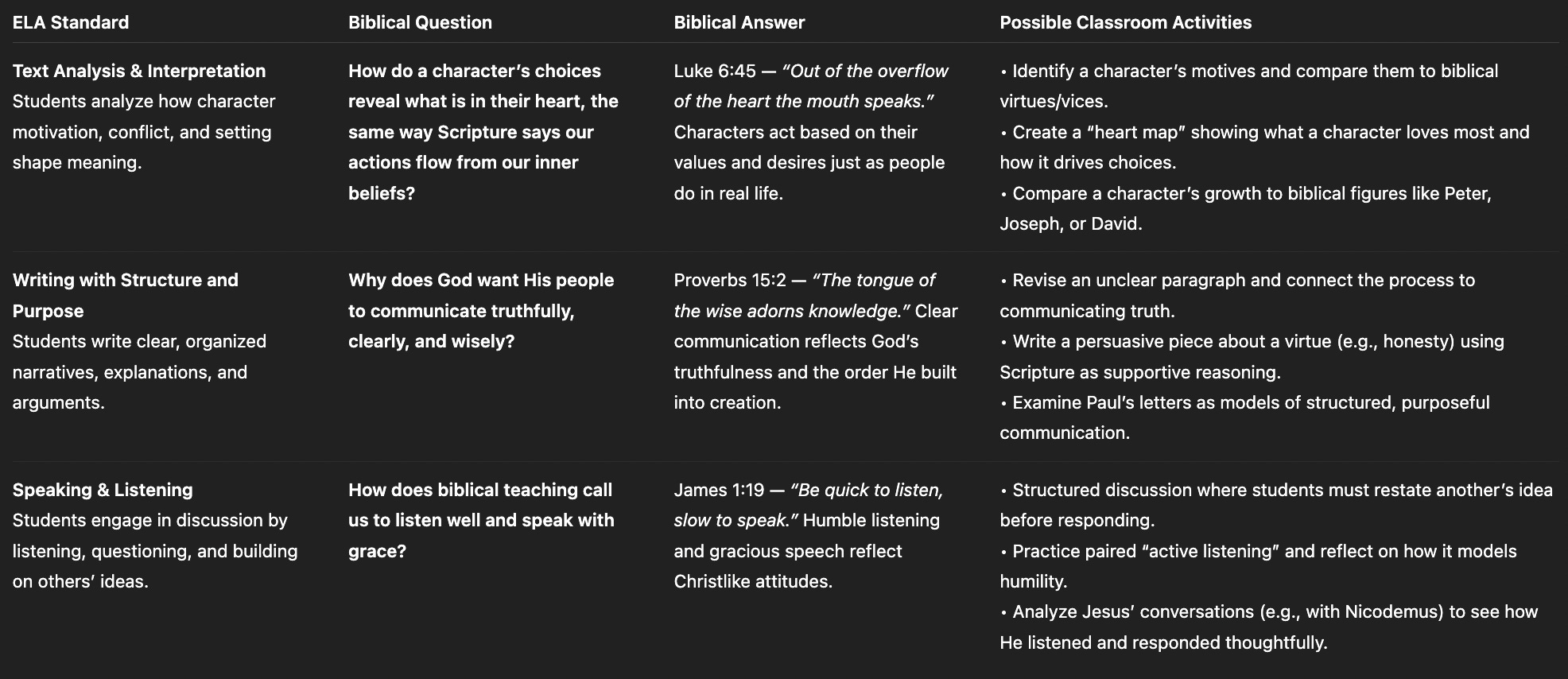
This model is clear, practical, and academically rigorous:
It respects learning targets.
It fosters deep biblical connections.
It produces meaningful learning activities.
It avoids superficial or cheesy “integration.”
More importantly, this allows you, like any other essential question, to continually come back to your biblical worldview question throughout your unit.
Why This Is So Important Right Now
As classrooms shift toward more personalized, differentiated, and small-group learning (Part IV), teachers may worry that integrating a biblical worldview will be harder.
In reality, it becomes easier because:
Small groups allow deeper conversations.
Teacher-led stations give space to connect Scripture to real skills.
Projects and hands-on tasks open doors for reflection and comparison.
Final Word
Biblical worldview integration is not a spiritual ornament on top of academic content. It is the content because it frames every academic pursuit within God’s story, God’s truth, and God’s design for His world.
As Christian educators, we should approach integration with the same rigor and clarity that we bring to teaching standards, analyzing data, or designing small-group rotations.
My prayer is that students would begin to see the Bible as both relevant and resourceful when thinking about math, ELA, science, or any subject for that matter. (Especially when biblical literacy is at or near an all-time low.) It also makes for more honest biblical worldview integration. In other words, we don’t force answers to questions to sound spiritual. For example, if you’re teaching about macroeconomics, zoom out of the lesson and think about the larger scene. You might have an essential unit question as follows:
How do big economic forces like growth, inflation, and employment shape everyday life for individuals and society?
Think about a biblical question.
How does the Bible teach us to respond when economic forces like inflation, scarcity, or unemployment create uncertainty or hardship in society?
This type of integration makes me hopeful for what Christian education, at its best, can become.
Oh my goodness… so so many things to say about this topic that I’ll revisit another time. For now this is one of my favorite quotes from this share:
“Christian schools exist to disciple students, to shape their hearts and minds to know and follow Jesus.
Because formation is the mission, biblical worldview integration isn’t optional or supplemental. It is the way Christian education was designed to function.”
I also couldn’t help but smile at the Ai example. 😊 …Modeling it’s fantastic use… as a tool🙌. Game changer I tell ya… game changer.
There are several factors that come to mind that would need to be addressed to ensure the success of implementation and minimize the risk of it becoming a “ to do list item” that gets set upon a shelf that collects dust. The following are my opinion regarding how to provide a framework to minimize faculty overwhelm and increase capacity to provide thoughtful creativity to such an endeavor.
1. What: Start by providing to the teachers, biblical worldview concepts the school views as priorities to be taught, starting with concepts that help bring continuity with the Mission, Vision, and Values of the school.
Why: For the mission, vision, values of the school to be taken seriously they need to be tied to the biblical worldview anyway. The biblical worldview concepts also needs to come from administration ( initially), because it can’t be assumed teachers know how biblical worldview concepts fit within the curriculum. The reality is that most teachers were not taught through a biblical worldview lense themselves. Even if they went to Bible college it might not have been related to subject matter across disciplines. If we want teachers to create beyond the Fruit of the Spirit, it’s best if at least at first the priorities are provided.
How: Make this a priority during teacher inservice sessions. Teach the worldview concept to the teachers. If it’s discovered they don’t agree with biblical worldview, it would be better to know this at the beginning of the year than when they avoid teaching it to students because they don’t actually believe it.
2. What: If it is a priority to create lessons that integrate biblical worldview with existing curriculum units then it’s best administration models this by making time to work on it a priority during teacher inservice days and is actively available to coach and answer questions regarding specifics when needed.
Why: If it’s not enough of a priority for administration to devote time during inservice sessions the perception will be that it must not be a serious priority. Teachers will be more likely to finish creating a lesson at home on Sat. when needed, if administration proved it was an important school project by not filling inservice with other random content that is lesser priority in reality.
How: Make this a second piece to inservice. First piece is learning the biblical worldview content during several sessions by subject. Second piece is applying the knowledge of the biblical worldview concept, to the application of connecting it to subject units. This would be done at the beginning of the year and during inservice days throughout the year,
3: What: Make it less daunting for staff by having specific grade levels focus on specific subjects to biblically integrate.
Why: This allows their mind to just focus on one conceptual application at a time. It will still allow students to get biblical worldview application alternated by subject until there is more time for the school to have more lessons as time passes.
How: 1st year of Implementation: For example K- Sosial Studies,
1st grade Science, 2nd grade History, 3rd grade Reading Comprehension… then possibly repeat…
2nd year of implementation have 2 Subjects implemented per grade, yet still staggered from the other grades so that within 2 years students can be exposed to the implementation of all 4 subjects.
Fun stuff! So appreciate this topic. 😊🙌